Clean dirt disposal requires precise logistics due to extreme bulk density. Dry soil averages 2,000 to 2,700 pounds per cubic yard, meaning wet clay or dense subsoil can rapidly overload road legal thresholds…
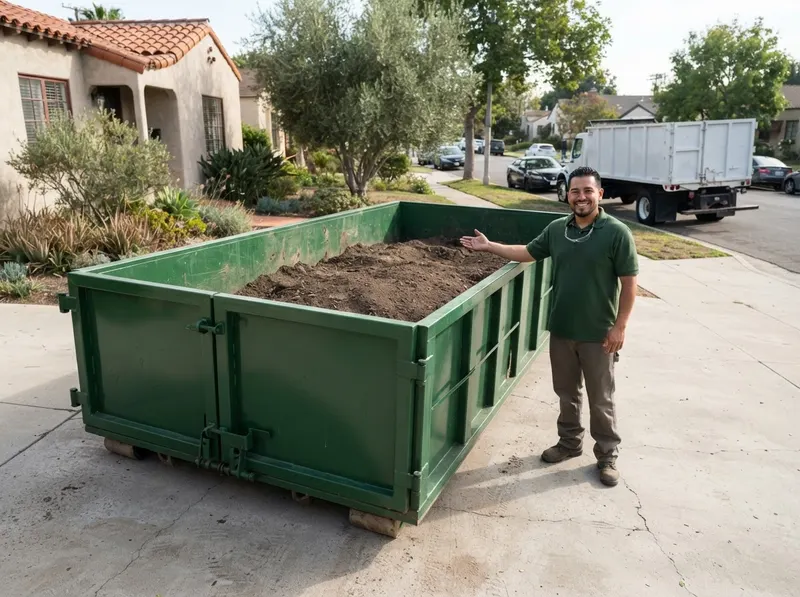
Clean dirt disposal requires precise logistics due to extreme bulk density. Dry soil averages 2,000 to 2,700 pounds per cubic yard, meaning wet clay or dense subsoil can rapidly overload road legal thresholds established by the California Department of Transportation. For projects across hillside neighborhoods like Silver Lake, Echo Park, and Los Feliz, steep grades and winding roadways demand specific truck maneuvering. Placing dedicated containers on narrow inclines requires high-tensile ground blocking to protect finished asphalt and stamped concrete from gouging, aligning with municipal street maintenance standards monitored by StreetsLA. Choosing a 10-yard container ($695) or a 15-yard container ($750) provides the ideal physical footprint for residential grading and pool cut-outs, preventing the truck from exceeding legal axle limits, whereas larger 30-yard ($895) and 40-yard ($995) bins accommodate expansive, commercial acreage leveling with lighter, aerated topsoil fills.
Contamination thresholds govern inert recycling facilities. To maintain flat-rate billing without unexpected sorting penalties, the loaded fill must remain strictly clean earth. When excavation crews mistakenly blend root balls, sod layers, or landscape fabric into the container, transfer yards reclassify the load under mixed construction standards regulated by the California Department of Resources Recycling and Recovery. This distinction is critical for remodelers in Brentwood, Mar Vista, and Venice navigating municipal green building codes enforced by the Los Angeles Department of Building and Safety. Clean dirt goes directly toward beneficial reuse, such as daily landfill cover or foundational site stabilization, whereas contaminated loads require mechanized screening under standards documented by the ASTM International soil testing guidelines, which immediately triggers tipping fee surcharges.
Urban site placement introduces tight right-of-way conditions that require active coordination. Driveways in densely populated sectors like Koreatown and North Hollywood frequently feature overhead utility lines governed by the Los Angeles Department of Water and Power or tight clearances bordered by low-hanging trees tracked under the USDA Forest Service urban canopy guidelines. When off-street private driveway placement is impossible, common on zero-lot-line properties near Boyle Heights or hillside pockets near Dodger Stadium, staging the bin on the public roadway necessitates an official street use permit coordinated through the Los Angeles Bureau of Engineering. For sites operating near protected open zones such as Griffith Observatory, Elysian Park, or the Kenneth Hahn State Recreation Area administered by Los Angeles County Parks and Recreation, stormwater protection requires sediment covers in line with best management practices issued by the United States Environmental Protection Agency to prevent loose silt runoff during unexpected rain events. In expansive valley regions like Woodland Hills, open jobsite staging simplifies placement, but prolonged ground contact on dry turf still requires protective wooden runners to preserve subterranean irrigation lines and maintain structural turf health.
Every job gets a firm, written price after a free on-site visit.
For standards, safe disposal, and service guidance on DUMPSTER in Los Angeles, CA, useful references include U.S. EPA, EPA, EPA, OSHA, Earth911, and Google Maps. General consumer and small-business resources are available from USA.gov, Better Business Bureau, FTC Consumer Advice, U.S. Small Business Administration, and Ready.gov.
Tell us about your clean dirt and soil roll-off dumpster job in Los Angeles and we'll send a clear, written quote, usually the same day.
 EverClean Waste Solutions